


Ticket to Dice - Trains Tracks
4.445.00 Reviews
App Specs
- Version
- 1.0.29
- Updated On
- License
- Free
- Downloads
- 10,000+
- Developer
- FunCraft Games
- Categories
- Board
- Platform
- Android
Screenshots



 Analysis by AppCompare
I spent time with Ticket to Dice - Trains Tracks as a casual board game built around routes, dice, and a map of the United States. Its central appeal is easy to understand: each turn asks me to make a small decision, then accept the uncertainty of a roll while trying to build a better network than the other players. That combination makes it approachable, but it also gives the game more room for tactical choices than its short store summary suggests.
FunCraft Games presents it as a free game for everyone, and the current release is version 1.0.29. The game has reached over ten thousand installs, with a 4.4 average from roughly two hundred ratings and several dozen written reviews. Those numbers suggest a modest but interested player base rather than a huge community, which is useful to keep in mind if you are looking for a board game with a very active social scene.
My overall impression is positive, especially for people who enjoy map-based board games but do not want to learn a long rulebook before starting. The more important question, though, is how comfortably the experience works for different players and situations. The map, route planning, dice results, and visual presentation all affect who can enjoy it without extra effort.
How the map and route choices read during play
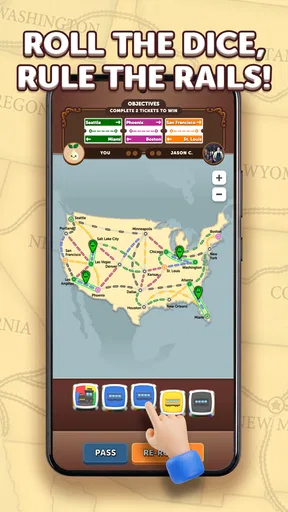
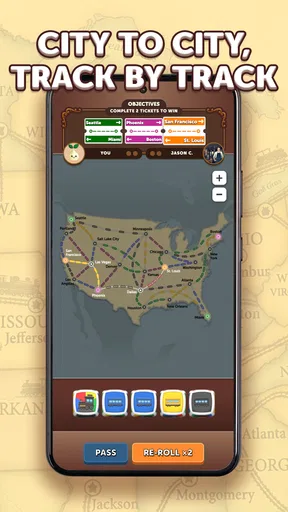
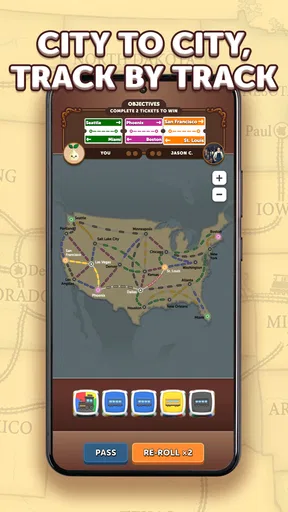
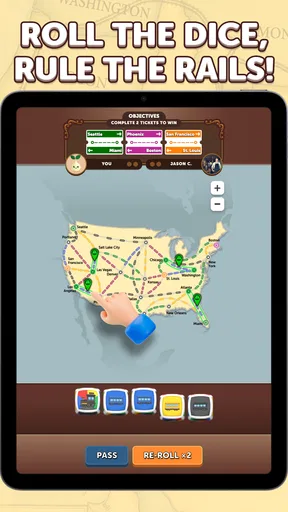
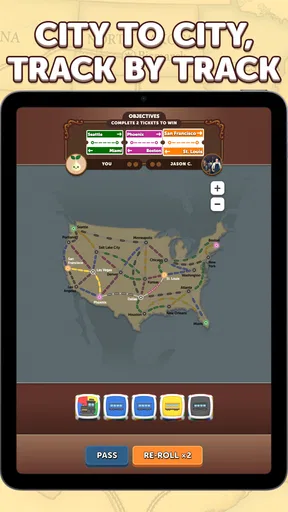
The United States map gives every session a clear visual purpose. I am not simply collecting abstract points; I am trying to connect places and decide which routes are worth pursuing before another player takes the opportunity away. That makes the board easier to understand than a purely symbolic layout, because the geography gives the action a familiar frame.
Navigation is strongest when I focus on one decision at a time. I look at the available route, consider what the dice may allow, and then decide whether to commit or wait. This rhythm helps new players because the game presents a recognizable loop: roll, evaluate, claim, and react. It also gives experienced board-game players enough tension to think ahead without turning every turn into a long calculation.
The main readability challenge comes from the amount of information competing for attention. A map-based board needs routes, destinations, player ownership, dice results, and opposing plans to remain distinguishable. When several claims develop close together, I have to pause and inspect the board rather than relying on a quick glance. That is not unusual for this kind of game, but it matters for anyone who finds dense visual layouts tiring.
I found it helpful to establish a personal scanning order instead of looking everywhere at once. I first checked my immediate route options, then the paths that could be blocked, and only afterward considered the wider map. This simple habit reduces visual overload and makes the game feel less hurried. It is also a useful way to introduce the game to someone who is unfamiliar with route-building board games.
Worth Reading Before You Choose

EA SPORTS FC Mobile 26 Is a Bigger Football Game, but It Takes Time

Flipboard Shows What News Apps Must Do Beyond the Feed

Switching to Android Auto Means Rethinking Your Driving Routine

Google Calendar Makes a Crowded Week Easier to Manage

Ludo King Makes the Most of the Minutes Between Plans

Baby Panda World Brings Quick Play to Modern Phones, but Its Game Library Feels Busy
Learning the decision loop without a long explanation
The dice make the first sessions forgiving in one particular way: I can understand the consequences by playing rather than memorizing a large set of exceptions. A new player can watch a route become available, see how a rival’s move changes the board, and gradually learn which opportunities deserve attention. That makes the game a reasonable choice for a family or group where not everyone already knows modern board-game conventions.
At the same time, the simplicity of the basic loop should not be mistaken for complete control. A careful plan can be disrupted by an unlucky roll, and that is part of the design’s personality. Players who want every outcome to follow from perfect strategy may find the randomness frustrating. I enjoyed the uncertainty more when I treated each roll as a reason to adapt rather than as a test of whether my original plan was correct.
One useful approach is to avoid building a strategy around a single route too early. I prefer keeping a backup connection in mind, even if it is less efficient. That trade-off is easy to miss during a first game, when the most attractive path can seem obviously correct. In practice, flexibility is often more valuable than chasing the most ambitious line on the map.
What the presentation means for different visual needs
The map-based format has a natural advantage for players who understand information spatially. Seeing routes connect across a recognizable country can make the objective easier to grasp than reading a list of destinations. Someone who enjoys diagrams and board layouts may find the structure intuitive after a few turns.
However, visual familiarity does not automatically mean universal clarity. Small route details, overlapping claims, and changing board states can demand sustained attention. Players with reduced vision, color-vision differences, or difficulty distinguishing similar visual elements may need to inspect the board more carefully. I would not assume that every route or ownership distinction will be equally clear for every person.
For a shared session, I would recommend placing the device where everyone can view it directly instead of passing it around after every action. That reduces repeated reorientation and lets players discuss the same board position. It also helps a player who needs a little more time to interpret the map without feeling that the group is waiting on a hidden decision.
Motor, sensory, and situational access
From a motor perspective, a turn-based board game is generally less demanding than an action game. The important actions are deliberate choices rather than rapid swipes or precise timing. That makes the experience more suitable for players who prefer a slower pace or who find fast reactions uncomfortable.
Still, turn-based does not mean effort-free. Selecting a route, handling dice results, and confirming a claim can require accurate touch interaction. If someone has limited fine-motor control, tremors, or difficulty with small touch targets, the practical experience may depend heavily on the device and how comfortably it can be held. A larger screen may make the map easier to inspect, while a smaller phone can be more convenient to grip but harder to read.
I also noticed that the game’s mental workload can be more significant than its physical workload. I need to remember my intended connection, watch what opponents are taking, and decide whether a poor roll calls for patience or a new plan. For players who tire quickly from multi-step planning, shorter sessions or cooperative discussion with a friend may make the experience more comfortable than trying to optimize every move alone.
The dice introduce a sensory and emotional consideration as well. Random results create suspense, but repeated unlucky outcomes can feel discouraging, particularly for someone who prefers predictable progress. I think the best audience is comfortable with a mix of planning and chance. If uncertainty causes stress rather than excitement, a deterministic puzzle or a more purely strategic board game would probably be a better fit.
Playing in ordinary daily situations
This is the kind of game I can imagine using during a short break, while waiting for an appointment, or during a relaxed evening when I want something more engaging than a very passive game. The route objective gives a session a clear shape, so I do not need to invent my own reason to continue. I can make a few decisions, stop, and return later with a sense of what I was trying to accomplish.
For a family setting, it could work well when one person enjoys board games and another prefers simple rules. I would begin by explaining only the immediate goal and letting the map teach the rest. After the first session, I would discuss the backup-route idea and the danger of focusing too heavily on one connection. Those are more useful lessons than giving a new player a complete strategy lecture before the first roll.
It may be less comfortable in a noisy environment. The board itself is visual, but the reasoning around it benefits from concentration, especially when several players are competing for related routes. On public transport or in a crowded room, a smaller screen and interruptions could make it harder to track the changing map. In that situation, I would choose a quieter board game or a simple puzzle instead.
Playing with someone who has different access needs also requires a little planning. A verbal description of the current route situation can help a player who cannot comfortably inspect every part of the map. Rather than saying only “your turn,” I would describe the meaningful options and the nearby rival claims. That does not change the rules, but it makes the shared experience less dependent on fast visual scanning.
Where it compares with familiar board-game alternatives
Compared with a classic dice game that relies mainly on luck, this title gives me more ownership over the result because route selection matters. A bad roll is not automatically the end of a turn’s value; I can still decide how to preserve future options. That extra layer makes it more satisfying for players who want their choices to matter.
Compared with a traditional route-collection board game played on a physical table, the mobile format is more convenient and less demanding to set up. I do not need to arrange pieces or remember where every card belongs. The trade-off is that the screen can make the board feel less tangible, and players who enjoy handling physical trains, cards, and tokens may prefer the tabletop experience.
It also sits between a pure strategy game and a casual family game. The map encourages planning, while the dice prevent the strongest player from controlling everything. That balance is useful for mixed-skill groups, although competitive players who want a tournament-like test of precision may find the random element too prominent.
The free entry point lowers the barrier to trying it, but the presence of in-app purchases ranging from ninety-nine cents to forty-nine dollars and ninety-nine cents per item is worth considering. I would approach those purchases carefully and decide in advance whether I want to spend anything. The game is easier to recommend as a low-commitment trial when I treat optional spending as separate from the basic decision to play.
Who should try it, and who may want another game
I would recommend it to someone who likes recognizable maps, short tactical decisions, and the tension of watching opponents compete for valuable connections. It is particularly suitable for players who enjoy board games but want a digital version that can be picked up without preparing a table or learning an elaborate system.
It is also a good candidate for a mixed group where one person is experienced and another is new. The rules are approachable enough to demonstrate through play, while the route choices give experienced players something to think about. A patient group can make the game more inclusive by allowing extra time to inspect the map and by explaining why a route matters instead of simply taking the strongest move.
I would skip it if you want a board game with no luck, a large competitive community, or a highly detailed simulation of rail networks. I would also look elsewhere if dense maps are difficult for you to read and there is no comfortable way to enlarge or clarify the board on your device. Those are not minor preferences; they affect whether the central route-planning idea feels enjoyable or exhausting.
Remaining barriers and practical ways around them
The biggest barrier is the dependence on visual interpretation. Even when the rules are simple, a player must understand the position of routes and claims. A device with a clearer, larger display may help, but it cannot solve every issue created by crowded map information. I would test a short session before recommending it to someone with significant visual access needs.
A second barrier is the combination of randomness and competition. A player who needs steady, predictable progress may not enjoy seeing a carefully prepared plan fail because of a roll. One way to reduce that pressure is to play casually with another person and focus on learning the map rather than winning. If that still feels frustrating, a non-random strategy game is a better match.
A third barrier is the possibility of spending pressure. The game is free to start, but the available purchase range means families should agree on a spending approach before handing the device to a child. The everyone age rating makes it broadly approachable, yet age suitability and purchasing comfort are separate questions. I would use the free experience first and only consider an item if I understood exactly what it added.
There is also a social barrier for players who prefer fully asynchronous or deeply collaborative play. The core appeal comes from reacting to rivals and competing over routes, so it may not satisfy someone seeking a quiet solo puzzle with no opponent pressure. In a group, clear turn-taking and verbal support can make it more welcoming, but the competitive structure remains part of the experience.
My inclusive verdict
Ticket to Dice - Trains Tracks succeeds because it turns a familiar map into a series of manageable decisions. I like that the dice keep the game from becoming rigid, while route choices give me enough control to feel involved. The best sessions are not about finding one perfect plan; they are about noticing when the board changes and choosing a sensible alternative.
Its accessibility is strongest in its relaxed, turn-based pace and approachable rules. Those qualities can help players who dislike fast controls or complicated instructions. Its weaker side is the visual and cognitive demand of reading a busy map, tracking rivals, and accepting uncertain results. Those limitations do not make it a poor choice, but they do make the device, setting, and playing group important.
FunCraft Games has made a free board game that is easy to sample and more thoughtful than a simple dice roller. I would recommend it to casual route-game fans, families willing to explain the board patiently, and anyone who enjoys adapting a plan after an unpredictable turn. I would choose a different option for players needing highly deterministic strategy, exceptionally simple visuals, or a more established multiplayer community. For everyone else, it is worth trying with a clear screen, a calm setting, and the expectation that flexibility matters as much as luck.
Pros
- Simple rules make it easy for new players to start quickly.
- Short matches fit well into casual gaming sessions.
- Strategic route choices add depth beyond basic dice rolling.
- Bright visuals make the board easy to follow on mobile screens.
- Offline play is useful when traveling or without a stable connection.
Cons
- Dice rolls can make some matches feel more dependent on luck.
- Limited variety may reduce long-term appeal for frequent players.
- Small board elements can be difficult to read on compact screens.
- Ads may interrupt the experience in the free version.
- The game may feel repetitive once the main strategies are mastered.
FAQs for Ticket to Dice - Trains Tracks
What is Ticket to Dice - Trains Tracks?
Ticket to Dice - Trains Tracks is a mobile board game inspired by classic railway route-building games. Players roll dice, collect matching colors, claim routes, and connect destinations across a map. Its appeal comes from combining luck with planning, since you must decide when to complete short connections, pursue longer routes, or block an opponent’s strategy.
How do you play Ticket to Dice - Trains Tracks?
Each turn generally revolves around rolling or using dice to obtain the colors and combinations needed to build railway tracks. Completing routes earns points, while destination objectives can provide additional rewards if connected successfully. Before downloading, keep in mind that the game is easy to understand, but winning requires paying attention to available routes, dice results, and the plans of other players.
Can Ticket to Dice - Trains Tracks be played offline?
Whether the game works completely offline may depend on the specific version and the feature you want to use. Local or solo gameplay may be available without a constant connection, while online multiplayer, advertisements, account services, and updates usually require internet access. It is worth checking the store description and testing your preferred mode before traveling or playing without mobile data.
Does Ticket to Dice - Trains Tracks support multiplayer?
Ticket to Dice - Trains Tracks is designed around competitive board-game play, so multiplayer is one of its most important attractions. Depending on the version, you may be able to play against friends, other online users, or computer-controlled opponents. Matchmaking, private games, and available player counts can vary between Android and iOS releases, so confirm the current features before installing.
Is Ticket to Dice - Trains Tracks free to download?
The app may be available as a free download, but the exact model can include advertising, optional purchases, or limitations on certain content. Free access does not always mean that every feature is unlocked immediately. Before downloading, review the store listing for in-app purchase information, supported devices, permissions, and any subscription details so you know what to expect.


